Number of records: 233
Recorded in: 94 1km grid squares
Date of most recent record: 31 viii 2024
Identification difficulty
: 2Species where care is needed for identification. Should not present any difficulty for experienced recorders, but inexperienced recorders may be expected to provide additional evidence in the form of photographs of reasonable quality that show as many of the identification features as possible or, alternatively, a specimen. Even experienced recorders may be expected to provide additional evidence if the record is outside of the normal flight period or geographical range of the species.
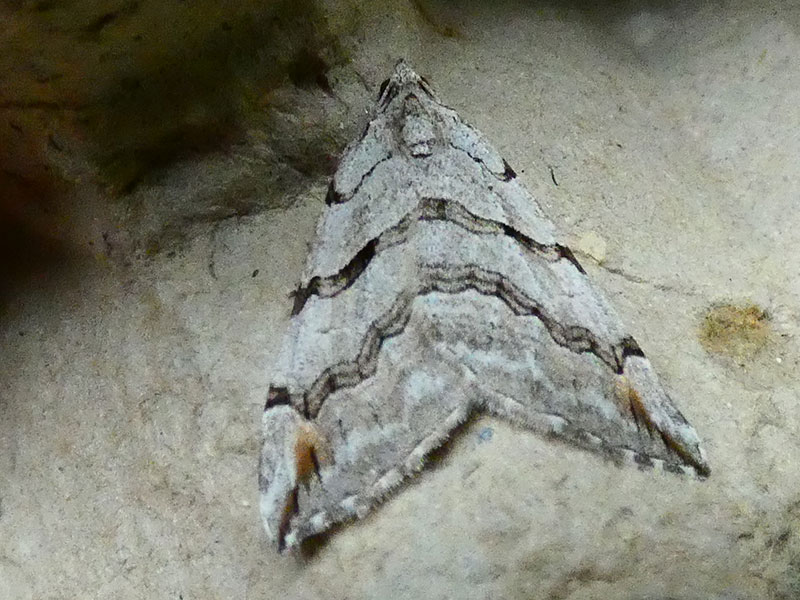
The Treble-bar generally occurs singly or sparingly at mv light but can be fairly common to common in West Sussex on the downs, amongst woodland and on heathland. In East Sussex it is currently known only from Lewes, although recent records suggest the moth is on the cusp of recolonising this vice-county. It is very local and irregular in numbers. Adults are on the wing in two broods throughout May and June and again from late July to early September. Larvae feed on St. John's-wort. (Pratt, 2011)
Rowland Wood, 9 viii 2015 Photo: Bob Foreman
Burgess Hill, 4 v 2026 Photo: Alan Gange
Steyning, 14 viii 2018 Photo: Olly Ellis
Hastings, 09 viii 2020 Photo: Angela Bogie
Bolney, 03 viii 2022 Photo: Howard Eastcott
Findon, 15 v 2021 Photo: John Christlieb
Telham, Battle, 19 viii 2018 Photo: Adrienne Norbury